
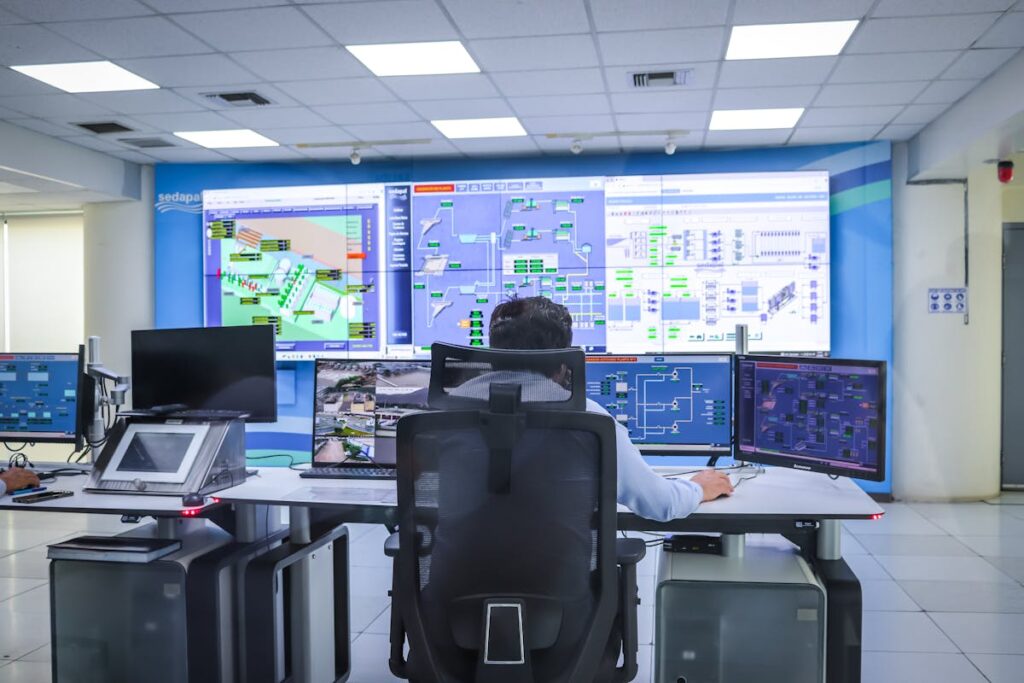
In the fast-paced competition of the modern manufacturing arena, speed, consistency, and precision are no longer “nice-to-haves” but survival requirements. Industry-wide, more and more companies are discovering Vision Systems incorporating Artificial Intelligence (AI) as an excellent way of accomplishing this.
Industrial Vision Systems are the force behind this revolution. These sophisticated technologies enable machines to “see,” process, and interpret images in true-time and perform functions like inspection, measurement, and sorting at rates of speed and accuracy unattainable by any human being. From recognizing the minute flaw in a product to tracking parts through each stage of production, AI vision systems are revolutionizing the organization’s approach to quality control and operational productivity.
Industrial Vision Systems
Industrial vision systems integrate hardware (cameras, lights, sensors) and sophisticated software and AI algorithms to take and interpret images for defined applications. Unlike conventional visual inspection, using manual checking, AI-powered systems are able to:
- Spot minute defects invisible to the naked eye
- Measure and sort parts to sub-millimeter accuracy
- Immediately verify assembly accuracy
- Continuous around-the-clock operations without fatigue or unevenness
By leveraging AI, these systems learn from patterns, adapt to new product variations, and provide actionable insights for process improvement.
Why Companies are Embracing AI Vision Technology
Consistent Quality Assurance
Manual inspection is prone to errors, especially in high-volume production environments. AI vision systems apply the same rigorous standards to every product, ensuring uniform quality.
Speedier Operations
High-speed cameras and instantaneous processing enable thousands of parts to be inspected per minute—matching the rate of even the quickest automated production lines.
Lower Operational Costs
Early detection of problems during the production phase avoids costly rework, scrap, and warranty claims.
Data-Driven Process Enhancements
These are not only defect-finding systems but provide sophisticated analytics, and they support predictive maintenance and end-to-end process optimization.
Real-World Applications
- Food & Beverage – Ensuring packaging integrity, detecting contamination, and verifying correct labeling to meet safety standards.
- Pharmaceuticals – Ensuring capsules, tablets, and packaging meet rigorous regulatory requirements.
- Automotive – Inspection of weld seams, paint coatings, and component positioning prior to vehicles exiting the factory floor.
- Electronics – Finding soldering defects, incorrect components, and assembly mistakes potentially leading to future failure.
How to Select the Appropriate Vision System
To invest in an AI vision solution, begin by understanding your production process. The proper provider will assist in finding where automation provides the greatest impact, provide proper hardware recommendations, and ensure AI models are calibrated to your distinct needs. Dealing with experienced professionals like Industrial Vision Systems guarantees a customized, scalable solution integrated into your current processes.
Also Read: How Can Strengthening Your Online Presence Improve Your Business?
For organizations thinking about an approach of automation, our article on The Benefits of Predictive Maintenance in Manufacturing offers details about further enhancing reliability and efficiency with AI technologies.
Industrial Vision of the Future
The next generation of vision systems will be even smarter and more autonomous. Advances in deep learning and edge computing will allow them to make complex decisions instantly, adapt to new products without retraining, and collaborate seamlessly with other AI-powered tools on the factory floor.
Industry experts such as the National Institute of Standards and Technology (NIST) conduct relevant research on future industrial automation trends, enabling companies to get ready for such an AI-led future.
Industrial vision technology adopters today are preparing themselves for a tremendous competitor advantage—integrating flawless quality, fast production, and data-driven knowledge to excel in the future of the manufacturing world.